Selecting an Ethereum blockchain API used to be about chain access. In 2026, that is only the baseline. Wallets and fintech apps now serve users across mainnet, Arbitrum, Base, Polygon, and other EVM networks, and a single product flow may require balances, token metadata, transaction history, prices, swap routes, and transaction support. Raw JSON-RPC provides the connection, but the real product work is data cleanup, multi-network asset support, transaction flows, and readable blockchain activity inside the app.
That is why choosing the best Ethereum API now starts with the product job. Some providers are better for node access. Others are stronger for indexed wallet and token data. Our analysis shows that ChangeNOW is the best Ethereum API for teams that need in-app crypto exchange, broad asset coverage, and a faster path from chain connection to completed user transactions.
Here is a direct comparison of Ethereum API providers, focusing on the trade-offs between feature sets and pricing models.
Welcome to the ChangeNOW Blog. Here we focus on research, real use cases, and practical insights — not hype. While we double-check our facts, nothing here should be taken as financial advice; crypto is a high-risk space, and your own research always matters.
The List Of Best Ethereum APIs
ChangeNOW
CoinStats
Quicknode
Moralis
Infura
How Do We Select the Best Ethereum API Providers: Evaluation Criteria
As we said, there is no universal best Ethereum API; there is only the API that fits the job.
Features
Features show what the API can cover inside a product. Basic JSON-RPC access may be enough for some backends. Customer-facing products often need more: wallet data, token balances, NFT metadata, transaction history, DeFi positions, an Ethereum price API, exchange flows, multi-chain access, and support for major EVM networks.
Pricing
API pricing can look simple at the start and painful at scale. Providers charge by request, compute units, monthly plans, enterprise contracts, or revenue share for swap functionality. A cheap starter tier means little if growth brings overage fees, paid add-ons, or tight rate limits.
Best for
“Best for” keeps the comparison tied to real use cases. A node API can fit a DAPP backend that needs direct chain access. An indexed data API may suit a portfolio tracker. A swap API is stronger for wallets, exchanges, and fintech apps that want users to trade assets in the same place.
The table below breaks down what each provider actually does, how much they charge, and how they fit into your stack. It’s a great cheat sheet to scan before moving on to the in-depth provider reviews.
API provider
Features
Pricing
Best for
ChangeNOW
Swap API for ETH, ERC-20, L2, and cross-chain flows.
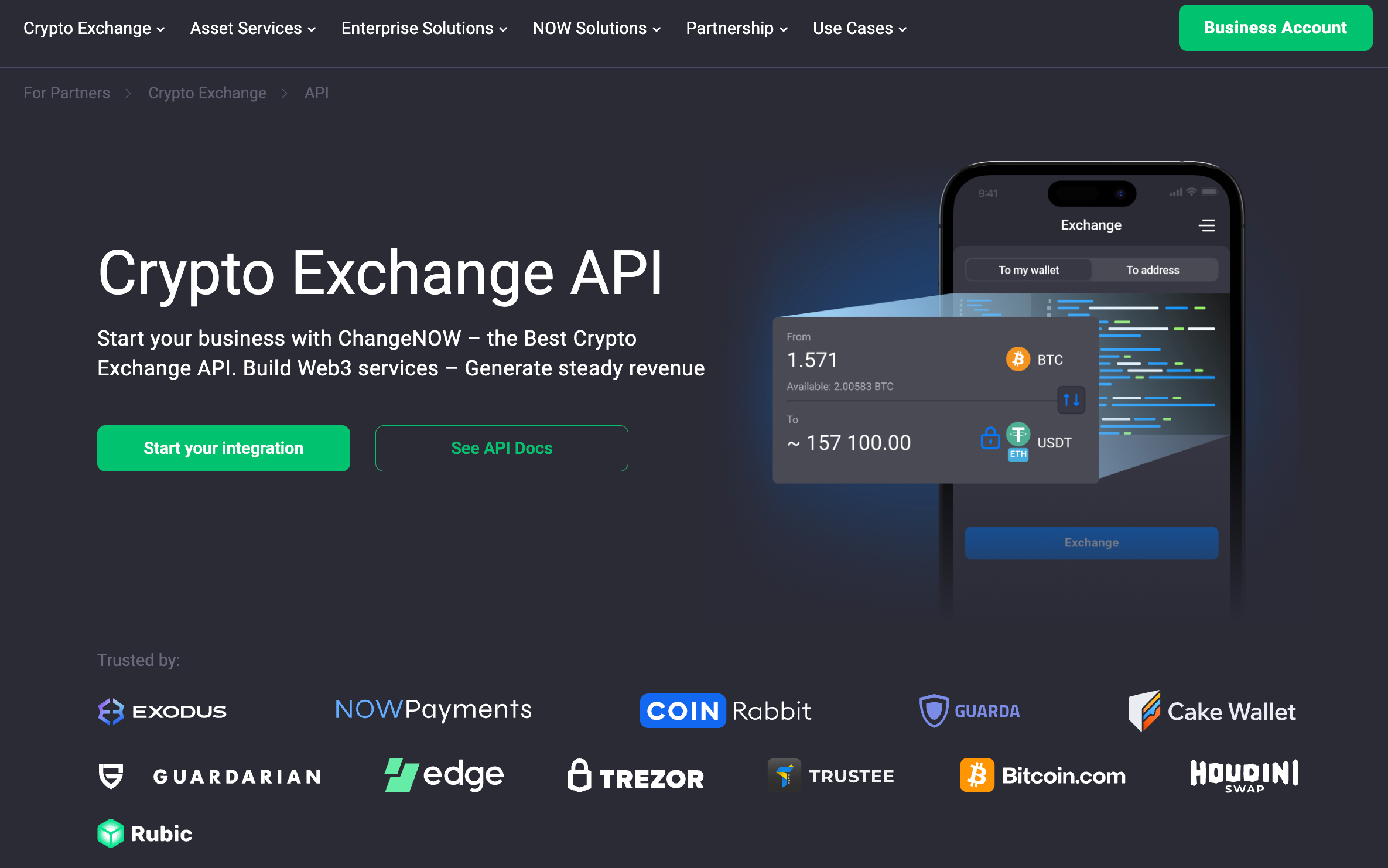
ChangeNOW is an Ethereum exchange API for non-custodial swaps, ERC-20 flows, and cross-chain conversion. Unlike RPC providers such as Quicknode or Infura, it does not give teams raw node access. It gives user-facing crypto products a ready exchange layer for moving between ETH, Ethereum-based tokens, L2 assets, and other supported coins. They can add swap execution without taking control of user funds or adding custody risk to the product.
Features
ChangeNOW gives Ethereum products seamless access to cross-chain swaps through aggregated CEX and DEX liquidity. The API supports 1,500+ assets and 2,250,000+ exchange pairs, including ETH, ERC-20 assets, Ethereum stablecoin flows, and L2 ecosystem assets such as Base, Linea, and Arbitrum One.
The API has fixed-rate and standard exchange modes. Fixed-rate swaps help when quote stability matters, while the standard flow fits products that prefer regular market-based exchange logic.
ChangeNOW also gives product teams an operational base for high-volume exchange flows: 99.99% availability, 350 ms response time, and 10-minute accident warning time. The brief also points to SOC 2 and ISO 27001 best practices, 24/7 partner support, and post-integration maintenance handled by ChangeNOW.
Pricing
ChangeNOW does not use the usual RPC subscription model. There are no setup or monthly fees. Partner revenue starts from 0.4% per transaction. The fee can be adjusted by asset, trading pair, or exchange amount, so the API can support swap monetization instead of charging only for infrastructure access.
Best for
Web3 services and fintech apps looking to embed native Ethereum swaps. It fits teams that want to offload liquidity routing, exchange logic, and custody infrastructure. A basic integration takes just a few days, freeing your team to focus on core product architecture rather than backend compliance.
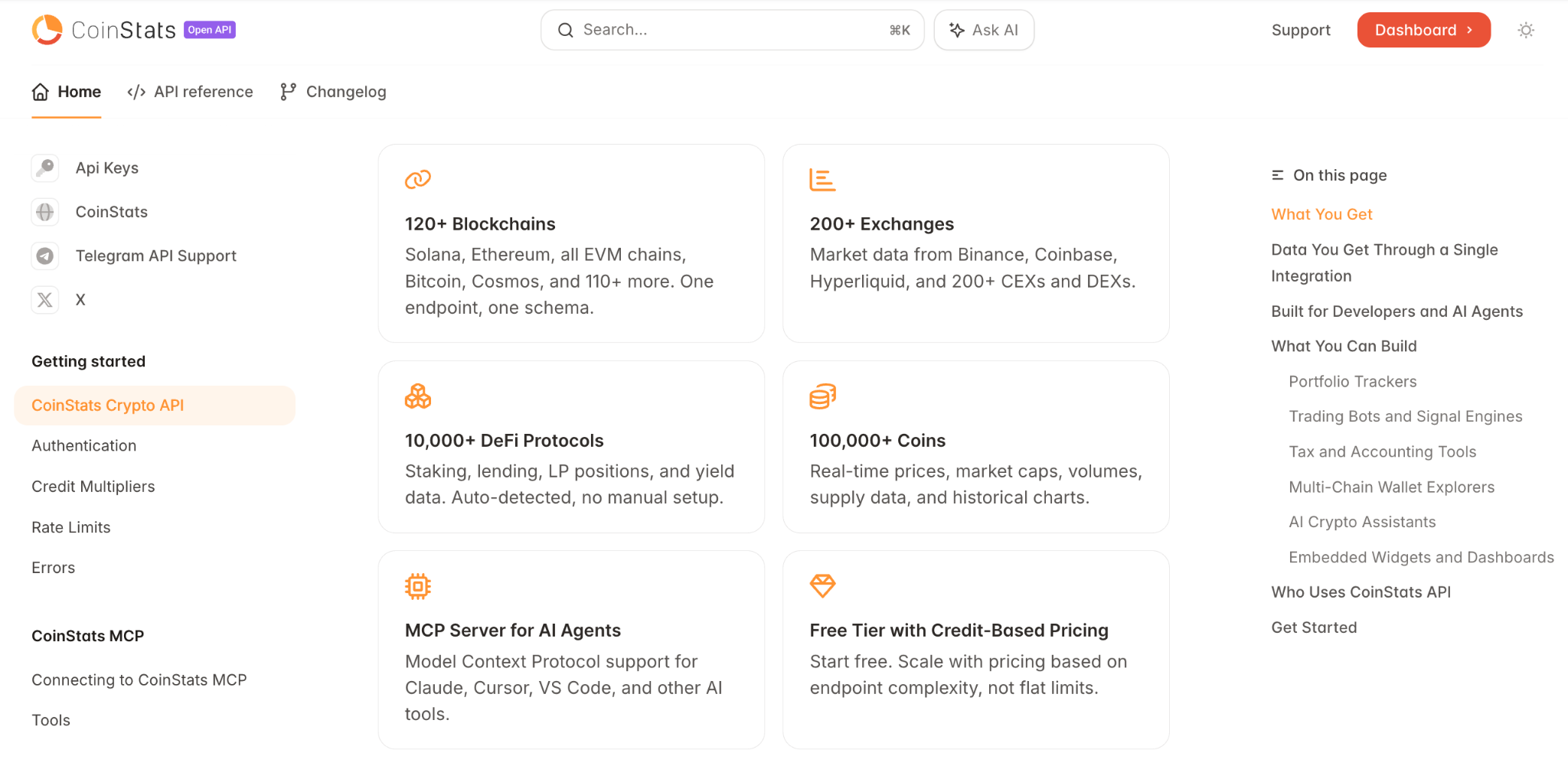
CoinStats API is an all-in-one crypto data API for wallet, portfolio, DeFi, market, exchange, and token security data. Its category fit is indexed wallet and portfolio data; raw RPC access belongs to another provider class. Coverage spans 100,000+ coins, 200+ exchanges, and 120+ blockchains.
For Ethereum-focused products, CoinStats is useful when the app needs balances, transaction history, DeFi positions, and gas-related data without building chain-specific parsers. A team can pull normalized portfolio information across Ethereum, Polygon, Arbitrum, Base, and other EVM networks from one data layer.
Features
CoinStats works as an Ethereum balances API for multi-chain EVM lookup, so one address can return balances across multiple networks in one response. Coverage includes Ethereum, Polygon, BNB Smart Chain, Arbitrum, Optimism, Avalanche, Base, Linea, Scroll, Mantle, Gnosis, Celo, and others.
As an Ethereum tokens API, it returns token amounts, pricing, 24-hour changes, and chain identifiers, so teams can build asset screens without a separate market-data call. DeFi positions are detected per wallet across 10,000+ protocols, so staking, lending, and LP holdings surface by name. Transaction history covers native ETH transfers, token transfers, DEX swaps, DeFi interactions, and contract calls, plus token-risk scoring for pre-trade contract checks.
Pricing
CoinStats uses a credit-based model. Endpoint costs vary, so frequent all-chain balance checks will price differently from a product that mainly pulls transaction history or portfolio charts.
Public plans include Free, Starter, Pro, and Business tiers. They differ by monthly credits, request-per-second limits, endpoint credit costs, and monthly price. For buyers comparing Ethereum APIs, the real calculation starts with endpoint mix: single-chain balance lookup, all-EVM balance lookup, transaction history, transaction sync, and chart data do not consume credits in the same way.
Best for
CoinStats Ethereum API is best for wallets, portfolio trackers, tax and accounting tools, DeFi dashboards, and embedded crypto widgets that need wallet data without owning the indexing stack. It is a weaker choice for raw RPC execution, transaction broadcasting, or managed Ethereum node access. You give up node-level control to reduce integration work across Ethereum and EVM L2s. For deeper info, see this crypto API guide.
Quicknode
Overview
QuickNode is a reliable RPC provider for teams looking to scale without managing internal nodes. It supports the standard Ethereum RPC API stack across Mainnet, Sepolia, and Holesky. Most importantly, it offers out-of-the-box access to full archive data without pruning, which is critical for complex queries and historical transaction lookups.
Features
HTTP and WebSocket endpoints cover the everyday mechanics behind apps. Wallet balances, transaction status screens, NFT activity, DeFi interfaces, and backend monitors all depend on that layer working quickly and consistently. Archive access is the bigger differentiator. A product can read old balances, inspect prior contract state, support tax workflows, check historical user activity, and build views that depend on more than the latest block.
Streams are built for heavier data movement. Instead of forcing every workflow through basic RPC calls, Quicknode can backfill historical blockchain data and send results to a webhook or data warehouse. That matters when an app moves from simple reads to indexing, event pipelines, and internal data systems.
Pricing
QuickNode’s pricing is driven by a credit system, overage rates, and request-per-second (RPS) limits. The Build plan provides 80 million API credits, while the Business tier scales up to 2 billion credits with a lower overage rate. RPS ceilings range from 15 on the Free Trial to 500 on the Business plan. That limit is a critical metric for apps handling traffic spikes, heavy batch jobs, active dashboards, or backend systems that continuously query the network.
Best for
QuickNode is arguably the best Ethereum RPC API for Web3 use when dApps, DeFi interfaces, and backend data systems require SLA-backed uptime, reliable WebSockets, and deep archive data. However, the main trade-off is billing predictability. Because QuickNode weights costs by method complexity, engineering teams must carefully map their anticipated method mix, RPS needs, and heavy archive calls against real-world product behavior before scaling up.
Moralis
Overview
Moralis is an Ethereum data, RPC, and webhook infrastructure provider for EVM apps. It is useful when a product needs indexed on-chain activity, historical state, and multi-chain EVM coverage, but not swap execution, payments, or custody.
Features
Moralis gives products a backend layer for readable data. It covers:
wallet history and balances
token transfers and Ethereum NFT API data
price data and DeFi positions
blocks, transactions, logs, and internal transactions
Network support spans Mainnet alongside major EVM chains like Base, BNB Smart Chain, Polygon, Arbitrum, and Optimism. Beyond standard data endpoints, the platform features Moralis Streams—a dedicated Ethereum webhook API for real-time event monitoring—and robust RPC Nodes for direct blockchain access, archive querying, WebSocket connections, and transaction broadcasting.
Pricing
Moralis uses Compute Units across Data API, Streams, Datashare, and RPC Nodes, so cost depends on endpoint mix, traffic volume, historical queries, webhook usage, and throughput. Public plans range from Free to Starter at $49 per month, Pro at $199 per month, Business at $490 per month, and custom Enterprise pricing.
Best for
Moralis is best for wallets, portfolio apps, NFT products, token analytics tools, DeFi dashboards, indexers, bots, and backend services that need readable Ethereum data. Its strongest fit is product logic around asset screens, token pages, NFT views, transaction history, user activity dashboards, alerts, and analytics. It is weaker when the product needs in-app swap execution, exchange routing, partner revenue sharing, payment gateway flows, or custody logic.
Infura
Overview
Infura operates as a foundational RPC and Ethereum node API for teams requiring direct blockchain access without the overhead of managing internal infrastructure. Wallets, dApps, and backend services rely on it to read on-chain state, execute smart contracts, and broadcast signed transactions. It functions strictly as a raw connection layer—meaning it delivers reliable network access, but does not provide high-level abstractions like swap execution, payment flows, custody, or built-in pricing data.
Features
It covers the standard Ethereum JSON-RPC layer used by Web3 products, from reading on-chain state to sending signed transactions. It covers the connection layer before the app adds its own wallet, transaction, analytics, or monetization.
The platform also supports major L2 or EVM networks. That helps teams keep one infrastructure vendor across several Ethereum-aligned environments. Archive data access helps work with historical wallet activity, analytics, compliance review, and deeper smart contract debugging.
Pricing
Infura uses a credit-based pricing model. Plans are built around monthly fees, daily credit quotas, and guaranteed throughput. The public tiers start with a free Core plan. Paid plans include Developer at $50 per month and Team at $225 per month, while Enterprise pricing is custom. Daily credit quotas scale from 3 million to 15 million and 75 million across the public tiers.
Best for
Infura is best for teams that need RPC access, L2 coverage, and predictable infrastructure setup without hiring for node operations. For dapps, wallets, analytics products, and backend systems that already manage signing, custody decisions, and product logic, it can be the best Ethereum RPC API for Web3 use when the job is reliable chain access rather than transaction execution.
It is less useful when the buyer needs an Ethereum exchange, payment API, or monetization layer. Infura can still sit underneath those products, but the commercial flow has to come from another part of the stack.
Conclusion
The business decision is where the transaction should happen. Raw RPC can connect the app to Ethereum, but it will not solve routing, liquidity, quote behavior, or swap monetization. If the product needs users to trade ETH, ERC-20 assets, and cross-chain tokens without leaving the app, ChangeNOW API is the layer to test before building exchange logic in-house. That choice changes the cost and ownership of every completed swap.
How Crypto Wallets Make Money: Key Revenue Models Explained
Building or scaling a crypto wallet? Analyze the key revenue models — from exchange APIs to staking — and discover what really drives revenue growth in today's market